

The Chicago Fire’s roster is officially in line with league rules at the MLS roster compliance deadline, and moves this week ensure that there will be no issues heading into the beginning of the new campaign. The team needed several international slots earlier in the offseason, but that is no longer an issue as everyone on the roster is now accounted for.
At first glance, the Fire appeared one international slot short of compliance. In reality, Portuguese midfielder André Franco – who tore his ACL near the end of last season – is set to miss the first half of the year and will remain on the injured list until then. While on the injured list, Franco does not occupy an international slot – but the Fire must have one available when he is activated, likely after the World Cup break.
As they have in each of the last two seasons, the Fire will stick with the “2+4” roster construction model. This means that at least for the first half of the season, the team will have only two Designated Players, but an additional U-22 Initiative roster slot. They also receive an additional $1 million in General Allocation Money (GAM) – essentially extra cap space – and, if they stick with that model for the second half of the season, gain another $1 million GAM. They maintain the flexibility to switch to a traditional 3-DP model in the summer as well, but would not get the extra GAM for the second half of the season. Adding a third DP would also push one U-22 player (likely Viktor Radojević) to the senior roster, requiring allocation money to cover the extra budget charge.
Where the rosters stand
In MLS, each team’s official 30-man roster is split into a 20-player senior roster and a 10-player supplemental roster. The heavy hitters and big earners make up the senior roster, while the supplemental roster typically consists of budget players, backups, and homegrown prospects.
The senior roster contains all of the team’s top earners: DPs Jonathan Bamba and Hugo Cuypers, TAM players Jack Elliott, André Franco, Robin Lod, Anton Salétros, and Philip Zinckernagel, and U-22 players Djé D’Avilla, Puso Dithejane, Mbekezeli Mbokazi, and Viktor Radojević.
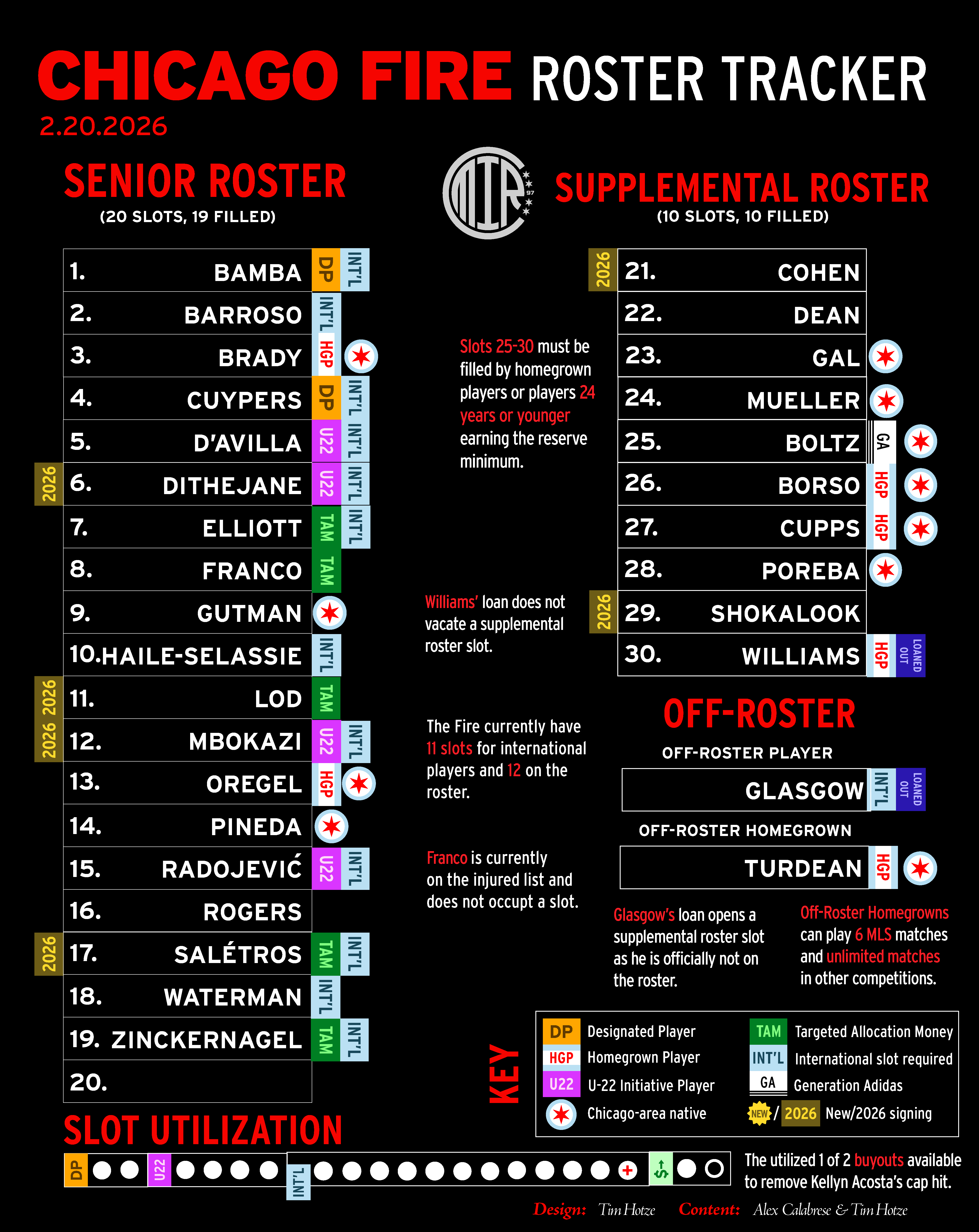
In a change from last season, Leonardo Barroso was moved out of a U-22 slot, with new signings Dithejane and Mbokazi taking his and Brian Gutiérrez’s places. Barroso’s lower cap hit (salary + transfer fee) made him an easier player to move out of a U-22 slot than Radojević. Radojević has struggled with injuries since arriving in Chicago and has yet to get on the field for the Fire in any capacity, but remains one for the future and will have plenty of opportunities to prove his worth once he is back to fitness.
This year’s supplemental roster is notably older than in previous seasons – the Fire are using those spots for first-team depth rather than developmental prospects. Josh Cohen (33), Jonathan Dean (28), Jeff Gal (32), and Chris Mueller (29) fill slots 21-24, while a younger set, including homegrowns Dylan Borso and Christopher Cupps, make up slots 25-30. Cohen had originally been on the Fire’s senior roster when he signed in December, but has been moved to the supplemental roster. 16-year-old Robert Turdean remains listed as an “off-roster homegrown player”, meaning he can appear up to six times in all competitions – though that seems unlikely as he has only just broken through with Fire II.
Glasgow, Williams loan details
The only outgoing moves of the last week were a pair of outbound loans for the Fire, who moved supplemental roster players Omari Glasgow and Sam Williams to the USL Championship. Glasgow joined Monterey Bay FC on a season-long deal, while Williams moved to the Colorado Springs Switchbacks. The two deals are different from each other, and have different roster implications.
Glasgow, 22, occupied an international slot on the Fire’s roster, and given his lack of minutes in the second half of 2025, a move made sense. Because the loan occurred before the compliance deadline, Glasgow is treated as a full “off-roster player” rather than occupying the club’s “slot 31” loan mechanism; his season-long loan vacates both a supplemental roster slot and an international slot. The off-roster player designation is not one the Fire have used previously, and it still allows them to recall Glasgow should they choose to do so later.

Williams, on the other hand, continues to occupy a supplemental roster slot. The 20-year-old midfielder primarily featured for Fire II in 2025, and likely would have done so again had he not been loaned out. The Fire also have an option to recall him should they see fit.
Each of these moves makes sense for the Fire with both roster standing and development in mind; Glasgow was unlikely to feature heavily in MLS but occupied a valuable international slot, while Williams would not benefit from more MLS Next Pro minutes at this point in his growth as a player.
Flexibility still
Crucially, the Fire still have plenty of flexibility heading into the season. They can feasibly sign a Designated Player in the summer, particularly relevant as they have continually been linked with a host of big names, most notably Robert Lewandowski. They also maintain the option for a second buyout should that be necessary to progress any moves.

Additionally, roster slot 31, an additional off-roster player with different stipulations, remains open. The slot was occupied in 2024 by Laurence Wootton and in 2025 by Bryan Dowd. Slot 31 essentially serves a holding spot for a player under contract who the team does not want using a roster slot – someone who does not count toward the 30-man roster unless temporarily called up in an emergency. Dowd was called up out of slot 31 on several occasions as the Fire only had two goalkeepers on their main roster and were granted severe hardship exemptions every time Chris Brady missed a game in net.
More importantly, as the Fire finalized their international slot acquisitions in recent weeks, they intentionally secured season-long slots rather than only trading for them for the first half of the season. This means that if any Fire players are able to initiate the U.S. Green Card process before the end of the summer, they would be able to vacate international slots, negating the need to acquire another one when Franco returns after the World Cup. If the Fire manage to have open slots over the summer, they could be able to trade them to other MLS teams – and given the potential influx of inbound moves to North America following the World Cup, the value of international slots could reach an all-time high.

Although international players can pursue U.S. residency, some nationalities – notably in this case from countries like Belgium and Switzerland – typically avoid it for tax reasons, making that path unlikely and impractical for the likes of Hugo Cuypers or Maren Haile-Selassie.
In short, unlike in previous years, where the Fire had to make moves to remain rules-compliant, this year’s roster was built to remain flexible. Completing their main transfer business in November and December paid dividends, and now they’re in a strong position to strengthen further come the summer transfer window.